Architecture
This section describes the current system architecture as implemented in this repo.
High-Level
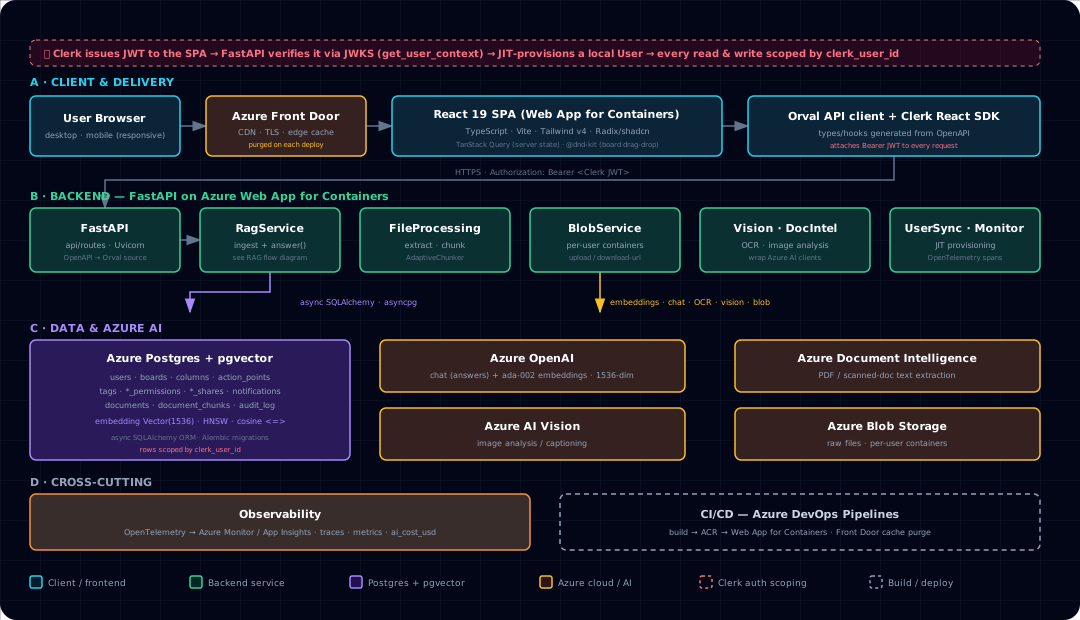
- Frontend: React + TypeScript (Vite), Tailwind, Radix UI, Clerk for auth, OpenAPI-generated clients (Orval).
- Backend: FastAPI (Python), async SQLAlchemy, PostgreSQL, Alembic, Clerk JWT verification, Azure integrations (OpenAI, Vision, Document Intelligence, Storage), OpenTelemetry.
- Infra: Docker images built in Azure DevOps, pushed to ACR, deployed to Azure Web App for Containers; CDN/Front Door in front of frontend.
Authentication & Authorization
- Clerk: Frontend obtains tokens via Clerk; backend verifies JWT with Clerk JWKS (see
backend/py/core/authentication.py). - Dual model (ADR-001):
ClerkUserfor verified Clerk identity and entitlement claims.- Local
Userfor DB relationships, ownership, permissions, and sharing via JIT provisioning.
- Use
get_current_userwhen you only need verified Clerk identity; useget_current_db_userfor DB filters and ownership checks. - Board and action-point access is user-scoped through ownership,
BoardPermission,ActionPointShare, and board placement.
API Layer
- Entrypoint:
backend/py/main.pydefines CORS, security headers, and includes routers. - Routers live in
backend/py/api/routes/*grouped by capability (kanban, board permissions, action-point sharing, comments, users, notifications, embeddings, document sharing, vector documents, workflows, webhooks, health) plus Azure-specific routes (AI, AI Vision, Blob Storage, Document Intelligence). - Response/request schemas live in
backend/py/schemas/. - OpenAPI is exported (used by frontend Orval to generate clients
frontend/src/api/generated). Keep it in sync.
Data Layer
- DB: PostgreSQL with asyncpg; async engine and sessions in
backend/py/db/database.py. - ORM: SQLAlchemy 2.x models in
backend/py/models/base.py. - Migrations: Alembic (
backend/py/alembic/*). - Common entities:
- Users:
User— local DB user, JIT-provisioned on first login. - Boards & work items:
Board,Column,ActionPoint,ActionPointBoardAssociation(junction table; per-board column and LexoRankposition, allowing an action point to appear on multiple boards),LinkedActionPoint(peer links between action points). - Permissions & sharing:
BoardPermission(explicit per-user grants on boards),ActionPointShare(cross-user sharing with snapshot and status lifecycle). - Tagging:
Tag,ActionPointTag,BoardTag. - RAG / documents:
Document,DocumentChunk(chunked text segments, each with aVector(1536)pgvector embedding — the core RAG table),DocumentPermission(per-user sharing permissions on documents),DocumentAccessLog(document-specific audit trail, separate fromAuditLog). - AI bot:
BotInteraction,BotGeneratedActionPoint(log of AI bot conversations and the action points they generate). - Supporting:
Comment,Attachment,AuditLog,Notification. - Legacy (deprecated):
Organization,Role,UserRole,Team— these models exist in the schema for historical reasons but are not part of the active architecture. The current build uses personal accounts only; the organization/team/role hierarchy is deprecated and not used in the active permission model.
- Users:
- Vector/embeddings:
DocumentChunkstores embeddings in a first-classpgvectorVector(1536)column (not a plain Postgres array). Similarity search uses the cosine-distance operator (<=>). Services inservices/*handle adaptive chunking, embeddings, and vector store (e.g.,adaptive_chunker_service.py,openai_embeddings_service.py,vector_store_service.py).
Document & AI Processing
- Uploads: Size/type constrained in
core/config.py; storage via Azure Blob. - Analysis: Azure AI Vision/Document Intelligence for OCR and structure, OpenAI (Azure) for embeddings and query workflows.
- Pipeline: services in
services/*provide adaptive chunking (adaptive_chunker_service.py), async document processing (async_document_processor.py), and vector storage (vector_store_service.py). - Deduplication/versioning:
Document.content_hash,versionand deletion flags prevent duplicates and manage lifecycle.
Health, Security, and CORS
- Health endpoints under
/health/*(liveness, readiness, metrics). - Security headers middleware (clickjacking, MIME sniffing, HSTS in non-dev).
- CORS origins vary by
ENVIRONMENT(prod, staging, dev) inmain.py.
Frontend Architecture
- Vite + React 19, TypeScript.
- State/data: React Query for server state; local component state for UI interactions.
- API client: Orval generates clients from
frontend/openapi.json→src/api/generated. Thin wrappers insrc/api/*andsrc/lib/api.ts. - Auth: Clerk React SDK (
src/config/clerk.ts), user sync overlay/gate to ensure backend JIT provisioning. - UI: Tailwind v4, Radix primitives, shadcn-inspired components under
src/components/ui. - Feature example: Kanban board uses
@dnd-kitfor drag/drop; board/action-point endpoints live under/api/kanban.
Deployment Topology
- Azure DevOps pipelines:
- API:
azuredevops/pipelines/api.yaml→ Docker build → ACR → Azure Web App for Containers (per dir, e.g.,py). - Frontend:
azuredevops/pipelines/frontend.yaml→ Docker build → ACR → Azure Web App for Containers → Front Door cache purge.
- API:
- Environments: dev and showcase active; prod config present but commented. Variable groups per branch.